
According to this article, The Port of Royal Slope wants to lease the old Milwaukee Road right-of-way from the State of Washington, to start moving freight once more between Royal City and Othello. The project has been on the Port's books now for at least three years, but at this point they have been getting no response from the state on how to proceed.
However this pans out, it will nice to see a transportation resource like this get reused in one of the more unique parts of our state. I'll be interested in comments from our readers in Eastern WA!
Showing posts with label Milwaukee Road. Show all posts
Showing posts with label Milwaukee Road. Show all posts
Friday, March 13, 2009


Saturday, January 10, 2009
Milwaukee Road's Tacoma Yard - Then and Now

The Milwaukee Road's Tideflats Yard in Tacoma was the end of the line for the nation's last transcontinental railroad. EMD F7 #81-A was one of the heavily-used "covered wagons" owned by the Milwaukee, photographed here by Sid Vaught in 1975. After the MILW abandonment in 1980, the yard eventually became part of Tacoma Rail's Tideflats Division and the rest is history.
Fast forward 32 years for the photo taken below at the same yard during Tacoma Rail's Open House in 2007. Believe me, those red & white switchers look better in person than they do on a on film shots taken during an overcast day!

Sunday, December 7, 2008
Rail Trail Spotlight - Snoqualmie Valley Trail
Sometimes the best way to understand history is to see what's left of it. That's what makes rail trails such a great resource to us, because we can see our state from the perspective of the railroader who contributed so much to making Washington a viable place. The routes left after railroads have abandoned them are usually easy to ride and a great way to view nature.
This quiet abandoned line was home to the once mighty Milwaukee Road. It's now part of a comprehensive trail system within King County that spans roughly 31 miles - past fast-flowing rivers, across highways, spanning massive trestles, and climbs effortlessly to Snoqualmie Falls then southeast towards Snoqualmie Pass. By horse or bike, the trail reintroduces even the hardest of urban visitors to what the whole of the Northwest once was - green, overcast, and undisturbed.
It's quiet and not well known. I started bicycling on this line back in the early 1990s, before King County began making improvements. Back then a person could ride from the intersection of State Route 203 & NE124th to SE 356th St between Fall City and Snoqualmie; at that point there was a bridge missing over a deep chasm in the hillside. Now the trail follows most of the old line, with the exception of a stretch of a couple miles that was reclaimed by landowners (riders are pointed towards SR 203 to get back to the trail). A person can still find rail spikes here and there along the route. While I've ridden most of it I've never ridden the entire length, which is a testament to its length of 31 miles.
Stories exist about the route,which ran from Monroe to the MILW connection at Cedar Falls, but to date I've been able to locate only a few photos of anything on the line - and nothing more recent than the early 1900s. I understand from one person who grew up in the area that the Milwaukee started running heavy U-Boats on the line in the 1970s in an attempt to reduce the amount of northbound runs over trackage-rights lines, which completely obliterated the light-grade rails and ballast. Derailments were pushed over the side and into the oxbow lakes that lined the route near Stillwater. While I don't know exactly when it was abandoned, I can't imagine it was in any usable shape by 1980 when MILW pulled out of Washington entirely.
Here's a few photos in a slideshow that I snapped recently along the route!
This quiet abandoned line was home to the once mighty Milwaukee Road. It's now part of a comprehensive trail system within King County that spans roughly 31 miles - past fast-flowing rivers, across highways, spanning massive trestles, and climbs effortlessly to Snoqualmie Falls then southeast towards Snoqualmie Pass. By horse or bike, the trail reintroduces even the hardest of urban visitors to what the whole of the Northwest once was - green, overcast, and undisturbed.
It's quiet and not well known. I started bicycling on this line back in the early 1990s, before King County began making improvements. Back then a person could ride from the intersection of State Route 203 & NE124th to SE 356th St between Fall City and Snoqualmie; at that point there was a bridge missing over a deep chasm in the hillside. Now the trail follows most of the old line, with the exception of a stretch of a couple miles that was reclaimed by landowners (riders are pointed towards SR 203 to get back to the trail). A person can still find rail spikes here and there along the route. While I've ridden most of it I've never ridden the entire length, which is a testament to its length of 31 miles.
Stories exist about the route,which ran from Monroe to the MILW connection at Cedar Falls, but to date I've been able to locate only a few photos of anything on the line - and nothing more recent than the early 1900s. I understand from one person who grew up in the area that the Milwaukee started running heavy U-Boats on the line in the 1970s in an attempt to reduce the amount of northbound runs over trackage-rights lines, which completely obliterated the light-grade rails and ballast. Derailments were pushed over the side and into the oxbow lakes that lined the route near Stillwater. While I don't know exactly when it was abandoned, I can't imagine it was in any usable shape by 1980 when MILW pulled out of Washington entirely.
Here's a few photos in a slideshow that I snapped recently along the route!
Friday, November 28, 2008
Milwaukee #356 - Then and Now
 Welcome to another Then and Now segment at WARail! In this post we focus on the once mighty Milwaukee Road.
EMD Serial #74610-1 was one of the many GP38-2 units built for the MILW in the early 1970s. This first Then and Now photo was taken at the Morton Depot in the summer of 1977. Morton is in the eastern part of Lewis County, near the southern end of former Milwaukee Road trackage (now owned by Tacoma Rail). MILW #356 was photographed by John Crosby, former Milwaukee Road employee and railroader. John had the sense to document a lot of MILW activity in the 1970s when he worked there; what he compiled then is now a rare look at a "Fallen Flag." This picture is only one of the many he has on file.
The second picture is of the same unit - now known as SOO 4506 - and was taken by Frank Rizzo during the summer of 2008 in North Dakota. That's 34 years to date on the rails...and counting! For those who might not know why this unit is now in SOO paint (and technically owned by Canadian
 Pacific), #356 was one of the many locomotives purchased by SOO Line when they bought all the bankrupt Milwaukee Road assets in the mid 1980s. For more pictures of the same unit over the years - in various paint schemes - click HERE!
In recent years there has been an awakening to the history of The Milwaukee Road and the years it served Washington. The Lost Rail blog does a great job of documenting the relics left from the line. There is a beautiful restored depot in South Cle Elum. Streets around former locations of Milwaukee Road properties are named things like...you guessed it...Milwaukee Rd, Milwaukee St, and Milwaukee Way. In Tacoma one can still see the tilted red rectangle of its logo painted on a trestle Sound Transit uses day in day out. The Milwaukee Road's "Tideflats Yard" is now the "Tideflats Division" of Tacoma Rail. The underdog of the Western rail expansion pulled out of Washington in 1980 before eventually disappearing into a paper trail around 1987. In its wake the Milwaukee left legends, stories, a kickin' logo, and a large number of Washington-based former employees spread from Port Angeles to the Idaho Border.
It's no secret that I love the Milwaukee Road. I won't hide that fact. My oldest son wears a Milwaukee Road hat because he too loves the Milwaukee Road. I even created a fictitious railroad called The Wilburton Line and based the logo on the famous angled rectangle. It's something in the colors, the versatility, and the fact that it ran here when I was in my formative years, even using trackage rights through East King County within earshot of my home.
If a person knows where to look, bits of "The Road" can be found all over Washington. Thankfully we have pictures like the ones above to see what was and what is still today!
Other Then and Now segments:
Saturday, November 8, 2008
Milwaukee Road at Othello, 1972
 CZ17 took this photo in Othello back in 1972, when the wires were still up and the GEs still ran. If you visit Othello today there is very little left of the Milwaukee Road. Even a caboose left town for South Cle Elum. But the city still associates with its railroad heritage. After all, the Milwaukee Road provided jobs and a connection to the world for 60+ years.
Othello is on Washington State Route 26, which runs 133 miles from I-90 to Colfax. Over the miles you can literally see the terrain change from scrub land to wheat field!
Wednesday, September 10, 2008
Oil-Electric: Milwaukee Road Box Cabs
I monitor the blog Oil-Electric, and when I see something about Milwaukee Road Box Cabs I just have to share it!
Oil-Electric: Milwaukee Road GE Motors - The "World's Mightiest!"
Oil-Electric: Milwaukee Road GE Motors - The "World's Mightiest!"
Thursday, August 14, 2008
Oil-Electric: Milwaukee's Bipolars
Robert McDonald wrote a blog post recently about the most unusual locomotives from an unusual railroad: the Milwaukee Road's Bipolar Electric. Powered by electricity, the Bipolar was so silent in operation that it could sneak up on a brakeman working a yard!
Saturday, June 14, 2008
Seattle and North Coast Video - 1982
Thankfully someone caught this short line on video before its demise! The Seattle & North Coast ran on former Milwaukee Road trackage on the Olympic Peninsula and had a very small yard in Seattle for the boat ride to Port Townsend. It's a shame it didn't last, because it operated in one of the most beautiful places in the state.
This blog post at Mile 15 gives a quick history of the SCN.
Sunday, May 11, 2008
The Secret of SODO
 Most every railfan can understand the thrill of finding a perfect spot to watch trains do their thing. Seattle's SODO ("South Of Downtown") district is one such place that lies humbly due south of the Safeco and Qwest Fields. This mostly industrial heart of Seattle is usually known by the sports teams that play in the stadiums to the north, but SODO also harbors a secret that brings smiles to railfans young and old. Like trains? You'll find them here in a big way. There's a busy multi-track mainline running north/south through the center, commuter rail tracks running nearby, and a busy international switching yard for BNSF. Add some of the common regional cloud cover to the Seattle skyline to the north, and you have a railfanning experience that is unique to Washington.
Railfanning in an urban environment is a far cry from the leafy snowy scenes of many railfan photos we see on the Internet. But urban railfanning has its own character. It's gritty, showing trains in a true light because they themselves are gritty. Because of its closeness to our home, SODO is
 a favorite destination for me and my sons - day or night. Photo opportunities are everywhere. Parking is easy to find unless it's "Game Day." SODO is flat, so even walking or bicycling the area is easy. The trains run often enough that visitors are treated to at least one double-stack unit train, or if timed right the Amtrak Coast Starlight. There are "garbage trains," mixed freight trains, commuters, passenger trains, engines running without cars from one yard to another, and even scrap metal trains. Switching work along the mainline and in other areas occurs almost 24/7. If you don't see a train when you get there, find some coffee (Starbucks World HQ is in SODO, and has a store just to the north on 1st Ave) and wait another 1/2 hour. The variety will keep any camera happy.
Finding SODO is easy; take the 4th Avenue exit of either I-5 or I-90 and turn right (south). Once you cross Royal Brougham Way, you're there. The busy BNSF Mainline runs parallel with 4th Avenue S and 1st Avenue S down the length of the area before entering a large freight yard south of Spokane Street. It also runs - literally - underneath Safeco Field's eastern end, and provides another unique experience: federally mandated crossing blasts from trains during Mariners games. A few years back the media tried to get BNSF to stop blowing the horns during the All-Star game "because it would ruin the broadcast." They were laughed out of the meetings.
 Since then it has come to be an expected and welcome part of a Mariners game, much like the Green Monster is to Boston.
Four major streets in SODO cross the Mainline: Holgate, Lander, Horton, and Spokane. Holgate and Lander both offer close public parking that will allow a railfan to troll the area with a camera. In fact, there is a Krispy Kreme at the corner of 1st and Holgate within ear shot of the mainline. Horton is a true gritty industrial street; parking is minimal but walking the area can often find a hidden road switcher or two. Spokane Street runs underneath the Spokane St Viaduct towards West Seattle; parking areas there are more congested, and making a left turn anywhere near the viaduct is difficult unless you know the backroads.

The BNSF International Gateway Yard was once called "Stacy Yard" and named for a street that doesn't intersect with it; this is a bustling place filled with switchers, trucks, and railcars of all types. Once owned by the mighty Northern Pacific and used extensively by the Milwaukee Road, the yard is home to some of BNSF's big new orange loading cranes - seen easily from 1st Avenue S. One of the most interesting things I've seen there, parked right along Colorado Avenue, was a trio of locomotives from the Alaska Railroad awaiting their boat ride back to the North. They were close enough to touch (of course that wouldn't be a good idea). A drive down Colorado can look different every day; sometimes the yard is entirely clear while other days it's so full a person can't see anything from the road. On the north end of the yard (Atlantic Street), switch engines use a track that runs directly underneath the Alaskan Way Viaduct to move their cars around. Parking nearby allows you to get out and get close to the action. Guaranteed dry railfanning in the winter time, thanks to the viaduct!
So if you're looking for a different railfan experience that doesn't include trees (unless those trees are bare and strung with wires), SODO can offer some uncharacteristic sites and sounds. Getting the true feeling for what goes on there takes several trips, or one really long one. But once you visit, it's sure to be a secret you'll share with all of your friends!
Saturday, March 15, 2008
The Milwaukee Road in Tekoa
 This remains as one of my most favorite photos from The Milwaukee Road. Taken in the last days of the company's work in the Western US, the shot captures the essence of the MILW. Lonely. Quiet. Working hard despite scarce resources. Although The Road survived until the mid 1980s, my feeling is that the glory days were long over by the time Paul Greenfield snapped this photo outside of Tekoa WA in 1979.
His backstory about the photo makes it even more interesting:
"The shot itself was an exercise in patience," Paul writes. "Myself and another railfan, Art Riordan, waited near Rosalia for about three hours in the late afternoon. We watched as the sun got lower and lower. We finally heard the Milwaukee dispatcher talking to this guy and he indicated that he was on his way to Rosalia. We then chased him eastward for as long as the light held. Chased being a relative word since the track was in such bad shape slow orders had him down to 15 or 20 mph. If he hadn't been so late we wouldn't have had this shot. Somehow it summarizes the lonely Milwaukee Road traveling off into the sunset."
I totally agree with Paul on this one. Chance, along with a lot of patience, captured this moment for history, and for that I'm eternally thankful.
Make sure to check out Paul's other railroading photos HERE!
Friday, March 14, 2008
Milwaukee Road Tunnel For Sale
Now's your chance! A former MILW tunnel is for sale for $650,000 outside of Tekoa WA.
Tuesday, December 18, 2007
MILW Trestle Getting New Deck for Trail
Peninsula Daily News recently reported that an old railroad trestle will get new life as Discovery Trail link. Volunteers from the Peninsula Trail Coalition will deck the near 100-year old structure with concrete and add to the constantly expanding trail that is built on portions of what used to be The Milwaukee Road's 14th Subdivision.
I rode portions of this old right-of-way back in the 90s on a bicycle. It's a shame that no trains run out that way anymore, because a ride up the Olympic Peninsula would be beautiful. Thankfully the Peninsula Train Coalition is accomplishing the next best thing by restoring much of the right-of-way to pedestrian and bicycle use.
I rode portions of this old right-of-way back in the 90s on a bicycle. It's a shame that no trains run out that way anymore, because a ride up the Olympic Peninsula would be beautiful. Thankfully the Peninsula Train Coalition is accomplishing the next best thing by restoring much of the right-of-way to pedestrian and bicycle use.
100 Years Ago: The Milwaukee Road Crosses the Columbia
The Othello Outlook posted a nice historic piece today, discussing the 100th anniversary of the Milwaukee Road crossing the Columbia River at Lind. Sounds like it was a big job, with unexpected geological problems and cold unending winds that drove workers away.
The writer Curt Andrews refers to the Milwaukee as "the St. Paul Railroad," a description I hadn't heard before. In an email today he explained this unique nickname as the manner in which The Milwaukee Road was called prior to 1927. So now I've learned something new! It would make sense that he would use that nickname for the article, since the subject occurred in the early 1900s.
Nice work!
The writer Curt Andrews refers to the Milwaukee as "the St. Paul Railroad," a description I hadn't heard before. In an email today he explained this unique nickname as the manner in which The Milwaukee Road was called prior to 1927. So now I've learned something new! It would make sense that he would use that nickname for the article, since the subject occurred in the early 1900s.
Nice work!
Friday, November 9, 2007
Northwest Railway Museum in Win-Win Land Deal
The Northwest Railway Museum in Snoqualmie has long been know as an advocate for railroad history and preservation. That task will become easier in the future, now that they have swapped a four-acre parcel near a county-owned park for a four-acre parcel right next door to their newly-built Conservation & Restoration Center.
Essentially this was a win-win for everyone involved.
One of the great things this does is it will move much of the Museum's stored equipment indoors out of the elements. This includes the Union Pacific 529 2-8-0 Baldwin steam engine, a Milwaukee Road box car, a Shay locomotive, and countless other examples of rolling stock. In a double-speaking little nugget of commentary, Snoqualmie's mayor Matt Larson says the move "will substantially change downtown Snoqualmie."
"Getting the trains indoors will keep them from deteriorating further."
Indeed, this is true. This statement also appears to be short hand for "I like trains, but some of our residents think they're an eyesore and hate looking at them every day." The Northwest Railway Museum started in 1957, years before many who have mounted land-use battles with them were even born. Young transplants to the sprawling Snoqualmie Ridge subdivision of the city sometimes don't appreciate the old equipment for what it is - a history marker of the Northwest's industrial past. Much of it sits in view of State Route 202, and has done so since my days of living nearby in the late 1960s. The Musuem's Restoration Center - known as the CRC - was embroiled in a land battle with neighbors who saw the facility as a deficit to their lifestyle; this added a few years to the project, but thankfully the CRC was completed and occupied in 2006.
It's great to see this group getting what it needs to preserve railroad history in the area. The towns and hills around it were once teaming with rail; The Milwaukee Road ran close to this former Northern Pacific line, and the few miles of track the Museum owns is now all that remains in this part of the county. It's essentially a land-locked railroad, since the Milwaukee tracks are all gone and the line west of Snoqualmie Falls was abandoned in the 1970s.
This land deal will help them maintain what's left and teach people the historic importance of rail here.
Sunday, November 4, 2007
Easton WA - Then and Now
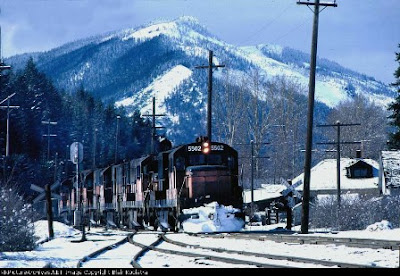
Mr. Blair Kooistra is a fellow railfan who has a good eye for machinery. He admits to putting worthy effort into even the simplest of railroading photos that he uploads. His collection of photographs online is nothing short of beautiful.
Blair was also on-hand to see the final hours of the Milwaukee Road in Washington when he took this simple photo in Easton WA on March 14, 1980. After that the lines in-state were either abandoned or sold to the Burlington Northern. In this photo you will see a long line of motive power, likely with many of the engines "dead in tow" to the Milwaukee's lines east of Montana. With Easton being within 70 miles of my home, I thought it would be fun to try duplicating Blair's photo almost 28 years later.
Turns out it wasn't as easy as I thought it would be.
My sons and I headed to Cabin Creek Rd. just south of downtown Easton and crossed the BNSF Mainline that still runs through. The Milwaukee Road, in this part of the state, has been replaced by the Iron Horse State Park which runs from North Bend to the Columbia River; it ran a few steps south of the BN at that time. This made Easton a true railroader's town. David and I got out of the truck with Blair's photo and started matching up landmarks. Much had changed and it didn't help that clouds were obscuring the hills to the north. As David and I were scratching our heads trying to find the right angle, to our fortune a woman was crossing the tracks and asked if we were waiting for the train. I told her what we were doing and she asked to see the photo. "I've lived in Easton all my life, and live in the oldest house in town." How cool is that? Right away she found the Tavern; it is to the right of the loco in the original photo with a centered chimney. In my photo below it has a red roof. She also showed us that the railroad crossing signs in Blair's photo were gone and that the fire station now had a new roof.
 Then and Now Mission completed, even if my current-day photo lacks the sizzle of the original. But now the mystery starts. In Blair's photo it looks like the Milwaukee was running on Burlington Northern trackage at the time, based on what I saw yesterday. Could this be? Was there possibly one of the many derailments that plagued the MILW towards the end that sent these engines to BN tracks? Or did the Milwaukee in fact run in a different place that I miscalculated? That is a mystery that can be solved by someone who knows the route far better than me.
After visiting Easton, we headed to South Cle Elum for a photo shoot with a MILW bayside caboose. It was a great day following in the footsteps of The Road!
Saturday, October 6, 2007
Under Jackson Street - Then and Now
Bikers call it "A Cage." I call it my truck, and to date it has whisked me and my sons to great railroading venues around the region. It's reliable, somewhat fuel-efficient (compare to my big block powered `59 Chevy anyway), and navigates easily around the area. But it's a cage. It's a cage to me because - at 30mph or more - I miss much of what is going on around the streets I drive. There's nothing like walking the same route I've driven, and seeing 10 times more simply because my speed is roughly 3mph instead of 30. For me, walking around downtown Seattle has opened up so much of the city's railroading history that it was simply astounding. During my stint of jury duty downtown, I focused my lunch break attention on King Street Station and the surrounding tracks/roads. I go away with a great understanding of the railroad through this area and its impact on the blocks just south of downtown.
The first picture in today's Then and Now segment was taken in 1948 of Great Northern 1450 on the GN mainline as it is passing underneath Jackson Street. UP's Union Station is situated behind the locomotive, which was shared with the Milwaukee Road (lettering on the right side of the building). An electric trolley runs under wire along Jackson Street to the right. If you look closely in the expanded photo, you will see above the locomotive, standing on the street, a 40s era railfan watching the train...in the same exact spot that I watched several trains go by yesterday. A man on Jackson is also giving the steamer a passing glance.
Thanks to the Sound Transit train station along the mainline, citizens today are able to stand safely along the tracks underneath Jackson to watch trains, although legally I'm not able to take a photo from the same exact spot as the 1948 picture. There are chain link fences and BNSF signs that keep ethical people from breaking the law. Being an honest railfan means following the rules, even if it means you have to give up on the sweet photo op.
So for this installment I have the best possible alternatives - a picture of Union Station in the modern day, a picture of an SD40 passing under Jackson from the other direction, and a picture taken directly under Jackson. For perspective the second locomotive with the white face is in roughly the same spot as 1450 was in the first photo. Not surprisingly, the architecture of the overpass hasn't changed; it's pretty crumbly underneath, but if it was unsafe the City of Seattle would shut it down in no time. Standing near the tracks you can see the soot of railroading's decades applied to the ceiling along with passive graffiti on the pillars like "SP&S Dave."
In the 35 minutes that I hung around, two double-stack trains, one mixed freight, and a commuter train switching tracks all made movements along this stretch. Now that I have a better idea on how to use the bus around downtown, it's likely I'll be back to keep up on what's happening along this busy line!
(compare to my big block powered `59 Chevy anyway), and navigates easily around the area. But it's a cage. It's a cage to me because - at 30mph or more - I miss much of what is going on around the streets I drive. There's nothing like walking the same route I've driven, and seeing 10 times more simply because my speed is roughly 3mph instead of 30. For me, walking around downtown Seattle has opened up so much of the city's railroading history that it was simply astounding. During my stint of jury duty downtown, I focused my lunch break attention on King Street Station and the surrounding tracks/roads. I go away with a great understanding of the railroad through this area and its impact on the blocks just south of downtown.
The first picture in today's Then and Now segment was taken in 1948 of Great Northern 1450 on the GN mainline as it is passing underneath Jackson Street. UP's Union Station is situated behind the locomotive, which was shared with the Milwaukee Road (lettering on the right side of the building). An electric trolley runs under wire along Jackson Street to the right. If you look closely in the expanded photo, you will see above the locomotive, standing on the street, a 40s era railfan watching the train...in the same exact spot that I watched several trains go by yesterday. A man on Jackson is also giving the steamer a passing glance.

Thanks to the Sound Transit train station along the mainline, citizens today are able to stand safely along the tracks underneath Jackson to watch trains, although legally I'm not able to take a photo from the same exact spot as the 1948 picture. There are chain link fences and BNSF signs that keep ethical people from breaking the law. Being an honest railfan means following the rules, even if it means you have to give up on the sweet photo op.
So for this installment I have the best possible alternatives - a picture of Union Station in the modern day, a picture of an SD40 passing under Jackson from the other direction, and a picture taken directly under Jackson. For
 perspective the second locomotive with the white face is in roughly the same spot as 1450 was in the first photo. Not surprisingly, the architecture of the overpass hasn't changed; it's pretty crumbly underneath, but if it was unsafe the City of Seattle would shut it down in no time. Standing near the tracks you can see the soot of railroading's decades applied to the ceiling along with passive graffiti on the pillars like "SP&S Dave."
In the 35 minutes that I hung around, two double-stack trains, one mixed freight, and a commuter train switching tracks all made movements along this stretch. Now that I have a better idea on how to use the bus around downtown, it's likely I'll be back to keep up on what's happening along this busy line!
Wednesday, October 3, 2007
Mobile Moment - King Street Station
 This week I've been on jury duty in downtown Seattle. Imagine my excitement when the bailiffs announce a two-hour lunch break; and here we are so close to tracks and trains! I skinned out the door and into the rainy Seattle streets to do what any railfan would do - eat my sandwich while looking for trains with my Treo 750/Camera Phone in hand. Sure, the quality of the photos taken by the Treo aren't up to snuff compared to even the most rudimentary 35mm SLR cameras, but frankly with some tweaking the photos end up looking better than those taken with a disposable. Sometimes you have to separate yourself from the desire to always be 100% and spot-on; I would have liked using my Olympus but the Treo does fine for what it is.
Closest venue for my Mobile Moment was our own King Street Station, recently sold to the City of Seattle by BNSF for the princely sum of one dollar. This will allow Seattle to get state and federal grants for renovation that were not available when it was privately held by the railroad. In any case, the station was potentially a great place for me to catch some trains and take some pix during my lunchtime - rather than sitting cooped up in the Jury Room.
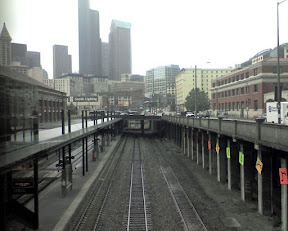
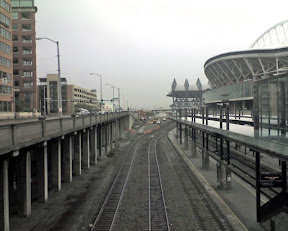
4th Avenue S runs on the left-hand side in the photo. In this part of the city, the railroad is literally underneath everything. On the other side of 4th Avenue is what's left of UP's Union Station, which has now been renovated into the headquarters for Sound Transit. The UP and Milwaukee Road ran out of Seattle's Union Station on a "stub track," which means the trains essentially backed up to the station and took on passengers. UP did not run on its own track north of here.
At this point, you might be thinking "doesn't this chowderhead take photos of actual trains?" Well, the best ones for last:
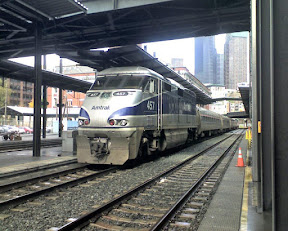
Amtrak 457 is an EMD F59PHI. On this day it was providing power for Amtrak Cascades, with the control car at the other end. Just before I took this photo a couple of homeless people walked across the tracks and then disappeared into the concrete maze on the other side. Some people just never learn about crossing tracks.
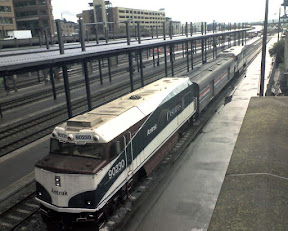
90230, for some reason, is called a "Cabbage Car." Essentially an "engineless engine," 90230 functions as a control car for Amtrak Cascades trains. Power is on the other end, usually in the form of an F59PHI like the one above but painted differently.
No BNSF trains came through at all while I was there, which was long enough to relax, eat, snap some pix, and even get close to Amtrak 457. But as I left and walked back towards 3rd and Yesler I could here the all-familiar howl of a BNSF horn coming up the track. Oh well...I should have stuck around another five minutes but who knew? That aside it was a great way to spend my lunchtime. I now know how to navigate around there on foot, so I should be able to take my boys along for the next tour of King Street Station!
Until next time, see you trackside...
Tuesday, September 18, 2007
Welcome to Washington Railroading

Welcome to WARail! This blog is written for railfans, by railfans, and discusses the sites and sounds that make up the diverse pattern of rails that spans the State of Washington. Much of the culture and mobility of this state can thank the railroad for establishing ways to get around and move goods. The look of the rail industry is also very different in each corner of the region; the Central deserts, the high plains East, and the rainy urban West. Mountain railroading is also alive and well in Washington, with two busy mainlines crossing the Cascades. The land is also criss-crossed with the ghosts of "Fallen Flag" railroads like The Milwaukee Road, clearly evident in the track beds of a bygone era.
While today there are only two "Class 1" or major railroads in Washington, the state has tracks and routes that belonged to a teaming list of road names - most now lost to history. The railroading history here is vast, and the track miles sometimes seem endless.
WARail is here to tell the stories of Washington Railroading from a railfan's perspective. This includes commuter rail lines, light rail operations, and "Short Line" railroads. We also monitor new stories that impact tracks old and new, and provide commentary on interesting photos and trackside photo opportunities.
So thanks for stopping by; we're glad you came!
Kurt Clark
Subscribe to:
Posts (Atom)

 Posts
Posts


